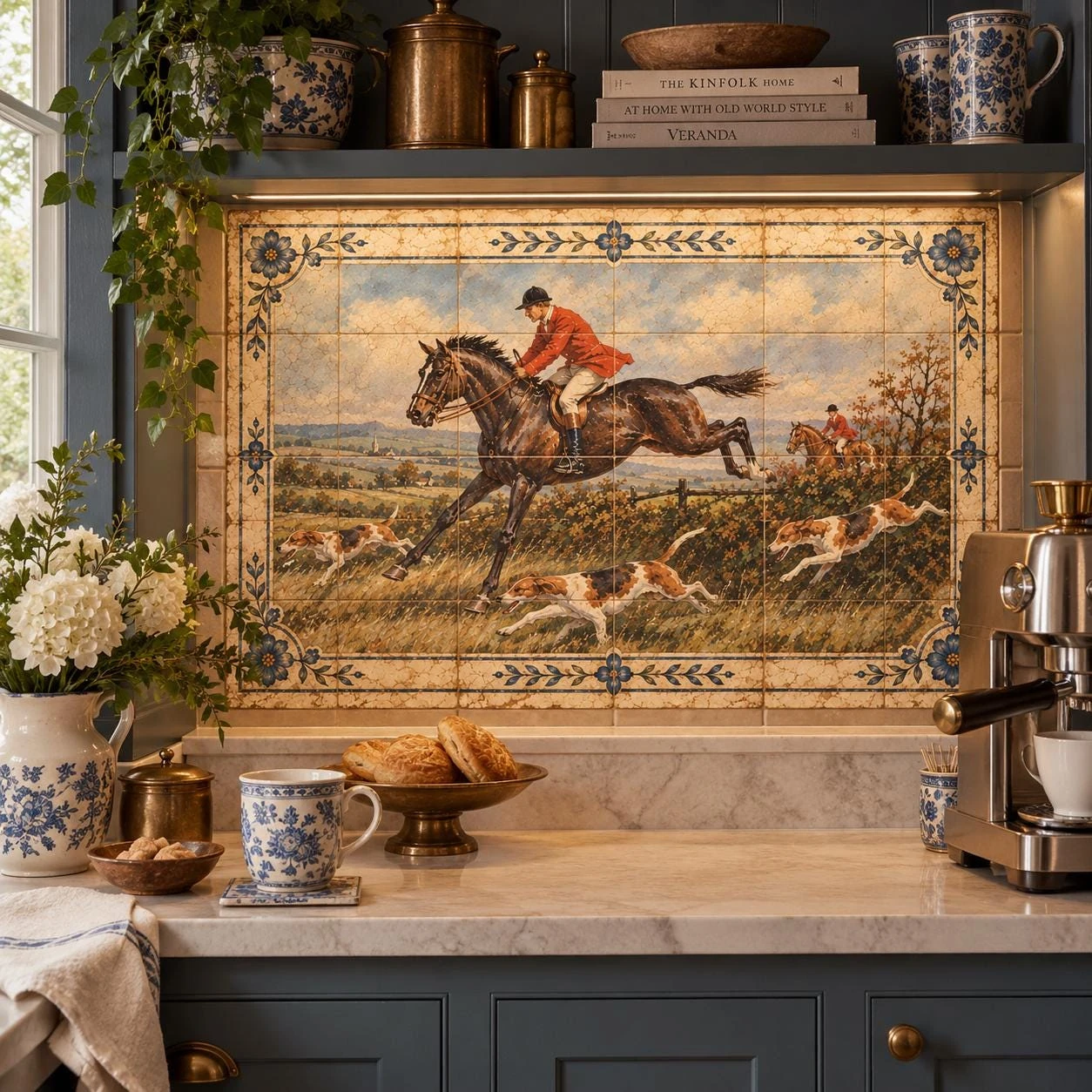
There is a particular energy in a sporting scene: a horse suspended above the grass, a red coat against a pale sky, hounds moving through a sweep of autumn color. Even when the room is still, the picture seems to carry the countryside with it. That sense of movement, companionship, and place is what makes fox-hunting imagery so compelling in a home.
To understand its decorative appeal, it helps to look beyond the familiar red jacket. Fox hunting has a long and complicated history, shaped by horses, working hounds, rural communities, social privilege, and changing attitudes toward animals. Its American story adds another layer: a European tradition adapted to different landscapes and sustained through local riding communities.
From European roots to American hunt country
Mounted hunting with hounds reached North America during the colonial period. The Masters of Foxhounds Association’s historical account records Robert Brooke bringing hounds to Maryland in 1650 and describes the sport spreading in Maryland and Virginia in the early eighteenth century. Imported European hounds and later breeding helped shape the American Foxhound.
At Mount Vernon, George Washington hunted during the autumn and winter and invited neighbors and associates to join him. Mount Vernon’s account presents the hunt as both demanding riding and a social occasion. It also identifies William Lee, Washington’s enslaved valet and huntsman, as a skilled equestrian and frequent companion. Remembering the people whose labor supported these occasions gives a fuller picture than the country-house image alone.
A tradition that changed with its surroundings
American fox hunting developed its own institutions. Piedmont Foxhounds was established in Virginia in 1840; the Masters of Foxhounds Association formed in 1907, initially to resolve disputes about hunting territory. The association’s history of mounted hunting also describes an evolution in quarry and practice: some North American hunts follow coyotes, while some practice drag hunting, in which hounds follow an artificial scent.
These distinctions matter. A ride behind hounds following a laid scent is different from pursuing a wild animal. Live-quarry hunting can harm or kill the animal pursued; describing the American tradition as a chase should not imply that it is necessarily harmless. Its history can be appreciated without overlooking that concern.
The legal story has changed too. In England and Wales, the Hunting Act 2004 made hunting wild mammals with dogs an offence except under specified exemptions, as summarized in a UK Parliament answer. That is a specific jurisdiction’s history, not a description of American law. A painted hunt scene should not be mistaken for a guide to contemporary practice everywhere.
In the United States, a hobby that becomes a passion
For enthusiasts, the attraction can extend well beyond the ride itself: learning a horse’s responses, watching hounds work together, knowing the terrain, and sharing an early morning with others who value the same experience. The preparation and relationships can make an occasional hobby into a lasting part of someone’s life.
A report of Chula Homa Hounds’ opening meet in Mississippi offers a glimpse of that community: riders and spectators gathered from several states for the occasion. It illustrates the continuing social life of the tradition beyond the best-known Virginia hunt-country setting.
Its future also depends on the people who own and care for the land. The MFHA’s landowner guidance emphasizes that relationship. Open country is someone’s home, farm, or livelihood; access and consideration belong alongside horsemanship in any account of rural sporting life.
Bringing the atmosphere into the home
You do not need to ride to respond to equestrian art. A hunting scene can appeal through its composition, its landscape, or a memory of horses and country walks. In decorating, the most interesting approach is to borrow that atmosphere thoughtfully rather than turn a room into a themed display.
Begin with one focal point. Above a coffee counter, an equestrian tile mural can introduce a landscape where there would otherwise be a plain wall. In a study or library, the same imagery can sit comfortably beside books, dark wood, and a well-used chair. Give the artwork enough visual space for the horse, hounds, and horizon to remain legible.
Let the image suggest the supporting palette. Antique cream can connect with plaster or painted cabinetry; muted blue works with blue-and-white ceramics; warm brown can echo wood and leather. A small note of red is often enough to pick up a rider’s coat. These are design choices, not rules: the aim is a relationship between objects that already mean something to you.
The Vintage Fox Hunt mural
Art By Tamri’s Vintage Fox Hunt Tile Mural brings together a leaping horse, mounted riders, running hounds, and a blue botanical border. Its deliberately aged finish combines parchment tones, softened countryside colors, and distressed texture. The effect is inspired by an old ceramic panel; it is a contemporary piece, not a historic antique.
The mural is offered as individual ceramic tiles in three configurations: 20 × 12 inches using 4-inch tiles, 30 × 18 inches using 6-inch tiles, and 40 × 24 inches using 8-inch tiles. Custom sizing can be discussed with the studio. Tiles arrive uninstalled; the surrounding cabinetry, framing, grout, and installation materials shown in lifestyle images are not included.
Before choosing a size, measure the finished space and review the tile layout with your installer. For a kitchen backsplash or a location near heat or moisture, confirm suitability and installation requirements for that specific setting with the studio and your tile professional.
The enduring appeal is a room with a story: a glimpse of landscape, a feeling of movement, and an object chosen because it holds your attention. Equestrian décor is most personal when it speaks to your own connection with horses, art, or the countryside.